The Real Impact of Static Electricity on Sound Quality in Vinyl Record Players
When using a vinyl record player, many people focus on the stylus, tonearm, turntable structure, and even the preamplifier but overlook a persistent and troublesome problem—static electricity.
Static electricity is not a mystical concept; it truly exists in every playback and every record-handling action and directly affects the sound quality, stability, and record lifespan of the vinyl record player.
Many people suddenly find that during a dry season:
- there is more background noise.
- the background is not clean.
- records attract dust easily.
- and records even “stick” to the inner sleeve as soon as they are picked up.
These phenomena are almost all related to static electricity.

Where does static electricity in a vinyl record player come from?
The material of vinyl records makes them “easy to generate an electrical charge.”
Vinyl records are primarily made of PVC, a material that readily accumulates static electricity through friction.
Static electricity is generated when the record rubs against the inner sleeve, contacts the turntable pad, or even comes into contact with air currents.
In a vinyl record player, the record is not stationary; it is constantly rotating and in contact, which means that the accumulation of static electricity is a continuous process.
The playback process itself is a “source of friction.”
During playback:
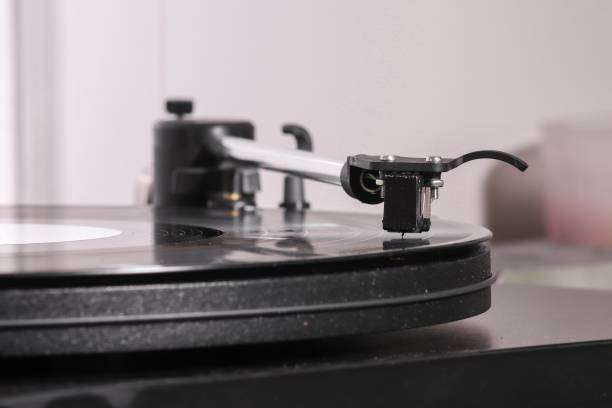
- The stylus slides at high speed in the record slot
- The record and the turntable remain in contact.
- Airflow and temperature and humidity changes superimposed
These will continuously create new electrostatic environments for the vinyl record player system.
In other words, even if you have cleaned the record, static electricity will still be generated again as soon as you start playing it.
Environmental factors amplified the static electricity problem.
When actually using a vinyl record player, you will find that:
- Static electricity is more likely to occur in winter or in air-conditioned rooms.
- The problem is more pronounced in rooms with lower humidity.
- Wooden floors and carpets are more prone to static electricity.
These are not accidental phenomena, but rather the result of static electricity becoming more difficult to release after the air humidity decreases.
How exactly does static electricity affect the sound quality of a vinyl record player?
Static electricity is not “inaudible,” but rather “audible.”
Many people underestimate the impact of static electricity, believing it merely attracts dust to records. However, in vinyl record player systems, static electricity translates into perceptible sound quality issues through multiple pathways:
- A faint crackling sound appeared at high frequencies.
- The background in the quiet section is not clean enough.
- The dynamic fluctuations appear rough and uneven.
These issues are not due to record aging or a problem with the stylus, but rather a result of electrostatic interference affecting signal stability.
Static electricity causes the stylus to “read things it shouldn’t.”
The stylus is essentially an extremely sensitive mechanical-to-electrical signal conversion device.
When the surface of the record carries static electricity:
- Tiny dust particles are firmly adsorbed in the soundbox.
- The stylus vibrates abnormally as it passes through these areas.
- After being converted into an electrical signal, it is amplified and output.
The result is that noise that was not originally there was faithfully amplified by the vinyl record player.
Static electricity damages audio-visual image and detail.
In terms of sound quality, static electricity often causes more subtle problems than just noise.
- The sound image localization is not stable enough
- High-frequency details appear tight
- Blurred sound field edges
These changes become more apparent after prolonged listening, especially when playing vocals, classical music, or jazz.
Long-term effects of static electricity on records and equipment
Static electricity accelerates record wear.
Dust attracted by electrostatic electricity does not disappear automatically; it will remain as the playback continues.
- Repeatedly crushed by the stylus
- Squeezing into the depths of the record slot
- Gradually forming sediments that are difficult to remove.
Over time, even a properly functioning vinyl record player will be unable to reproduce the original sound of the record.
Latent effects on the stability of the stylus and tonearm
When the surface of the record is heavily static:
- The stylus may experience slight jumping.
- tonearm tracking stability decreased
- Anti-slip setting becomes more difficult to judge
These issues won’t immediately damage the device, but they will keep the vinyl record player running in a “suboptimal” state.
Why are some systems more susceptible to static electricity?
High-resolution systems are more “honest.”
The higher the system’s resolution, the more obvious the problems become.
When a vinyl record player is paired with a high-sensitivity cartridge and preamp, subtle interference from static electricity is actually more easily heard.
This is why some people feel that there is more noise after upgrading their equipment.
Differences in usage habits amplify the problem.
Some daily operating habits can also affect the degree of static electricity accumulation:
- Frequent dry rubbing of records
- Use ordinary paper inner sleeve
- Touch the surface of the record directly with your hands
These details may not be noticeable in the short term, but they can significantly amplify the static electricity problem with long-term use.
How can we systematically reduce the impact of static electricity on vinyl record players?
Start with the environment, instead of just focusing on the record.
Properly increasing indoor humidity is the most basic, yet most easily overlooked, step.
When air humidity is kept within a relatively stable range, the overall performance of a vinyl record player tends to be more stable.
Correctly understand the difference between “cleaning” and “static removal.”
Cleaning ≠ removing static electricity.
Many cleaning methods simply remove dust without addressing the static charge issue.
A truly effective strategy should be
- Reduce friction sources
- Provide electrostatic discharge path
- Avoid rapid accumulation again
Make the playback process “gentle.”
Slowing down the process of picking up and putting down records, and avoiding unnecessary rapid friction, can significantly reduce the rate of static electricity buildup.
This change will not affect efficiency, but it will make the playback experience of the vinyl record player more stable.
FAQ:
Q1: Will static electricity always affect sound quality?
A: It’s not noticeable every time you play a song, but in quiet environments, high-resolution systems, or dry environments, the impact of static electricity on sound quality is very real.
Q2: Will new records also have static electricity issues?
A: Yes. New records often accumulate a lot of static electricity during transportation, packaging, and initial handling.
Q3: How to distinguish between static electricity and stylus noise?
A: Static noise is mostly random, fragmented popping sounds, while the noise generated by stylus wear is more continuous and regular.
Q4: Does grounding
Did the vinyl record player help? A: Proper grounding helps reduce overall system noise, but other methods are still needed to deal with static electricity on the record surface.
Q5: Will static electricity damage the equipment?
A: It usually won’t cause immediate damage, but it will indirectly accelerate the wear and tear on records and styluses.
Summarize:
In vinyl record player systems, what truly differentiates us is often not expensive equipment, but rather the understanding and respect for detail.
Static electricity may not be noticeable, but it can subtly affect your judgment of music.
When playback becomes cleaner, more stable, and more natural, you’ll find that those once-blurred details have always been there.
If you want to reduce static interference, improve playback stability, and allow your vinyl record player to deliver a more complete sound quality,
Start by adjusting the right accessories and usage plan to make each playback closer to the sound of the record itself.
Vinyl record player solutions for your system now, and let music return to its purest form.
Related Posts

Methods to Improve Distortion Issues in Vinyl Record Players: A Comprehensive Guide and Practical Tips
-
Posted by
 Carter Eleanor

Vinyl Record Players on Record Collecting: How to Choose and Maintain Records
-
Posted by
Carter Eleanor

