
When people first encounter a vinyl record system, they often focus on the turntable, tonearm, cartridge, and even the power cord, but overlook a factor that has a significant impact on the sound—the room itself .
In fact, a vinyl record player is not a “plug-and-play” device that works the same everywhere. Different room structures, materials, sizes, and furnishings will all have a significant impact on the final listening experience.
room but.You might find that
The same vinyl record player sounds relaxed and open in the living room, but becomes hollow in the study, and the low frequencies become more pronounced in the bedroom. This isn’t due to the device being “unstable,” but rather a typical effect of room acoustics .
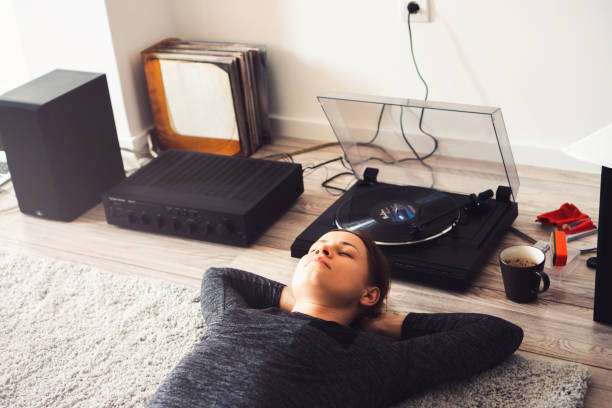
How do room acoustics affect vinyl record players ?
1. The basic functions of reflection, absorption, and standing waves
When a vinyl record player outputs music, the sound doesn’t enter your ears in a straight line; instead, it reflects, overlaps, and attenuates throughout the room.
Hard surfaces (walls, glass, floor tiles)
enhance reflection, making the sound brighter but also more likely to be harsh.
Soft materials (curtains, sofas, carpets)
absorb mid-to-high frequencies, making the sound softer.
An improperly proportioned room
can easily generate standing waves, which can amplify or attenuate certain low frequencies.
This is why vinyl record players are particularly sensitive to changes in “spatial perception”—the details of analog signals are more easily amplified or destroyed by the environment.
The impact of different room types on vinyl record players
1. Living room: Most common, but most prone to getting out of control.
The living room is usually the first place where vinyl record players are placed. It’s a large space with frequent activity, but the acoustic conditions are quite complex.
High ceilings can easily create echoes.
Large areas of glass and TV walls will increase high-frequency reflections.
Asymmetrical furniture distribution can easily cause sound image distortion.
If the vinyl record player is placed directly against the wall, the low frequencies will be further amplified, which may make the sound “muddy” and mask the details.
Optimization suggestions:
Keep the record player at least 30–50 cm away from the corner of the wall.
Use natural soft furnishings such as curtains and bookshelves to diffuse reflections
The left and right channels should be kept relatively symmetrical.
2. Bedroom: The sound is intimate, but the low frequencies tend to be excessive.
Bedrooms are often small, but their sound absorption is actually better (due to the presence of beds, wardrobes, and fabrics), which often results in the sound being absorbed by a vinyl record player.
The midrange is prominent, and the vocals are forward.
The low frequencies are more concentrated, but the depth is limited.
The overall sound is warm and intimate.
However, if the bed is too close to the corner of the wall, the accumulation of low frequencies will make the sound sound “muffled.”
Optimization suggestions:
The vinyl record player should not share the same wall as the head of the bed.
When there are more low frequencies, appropriately reduce the distance from the wall.
More suitable for listening to jazz, vocals, and small ensemble music
3. Study/Studio: Resolution is most easily demonstrated in this space.
The study is often one of the spaces where vinyl record players perform most consistently.
Spatial Relative Regularity
Books naturally have a dissemination effect.
Different furniture heights help to create a more even sound field.
In such an environment, the vinyl record player will have a clearer sense of layering and positioning, and the details of the stylus will be easier to hear.
Optimization suggestions:
The turntable platform must be stable to avoid resonance.
Try to avoid sharing the desktop with your computer speakers.
Ideal for long listening sessions

4. Open space: Large sound field, but energy is dispersed.
An open-plan living/dining area or loft space will give vinyl record players a “strong stage presence but insufficient density” feel:
Sound spreads quickly
Low frequencies are easily absorbed by the space.
The volume needs to be increased slightly to achieve a sense of depth.
Optimization suggestions:
More emphasis is placed on speaker placement rather than simply adjusting the volume.
Reduce the effective listening area by using carpets and soft furnishings such as partitions.
Avoid placing the speaker directly behind an open area.
Matching logic between room and vinyl record player
Many people ask:
Does a bad room mean you can’t listen to vinyl records well?
The answer is no.
The key is not whether the room is “perfect,” but whether you understand the room’s sonic character and let the vinyl record player work with the space, rather than fighting against it.
For example:
Small spaces prioritize density, not sound pressure.
Large spaces prioritize control over sheer size.
For rooms with lots of soft furnishings, pay attention to the analysis.
In rooms with a lot of hard furnishings, pay attention to softening the overall look.
Common placement mistakes
Vinyl Record Player in different rooms, the following problems are very common:
The record player is placed directly above the speaker.
Placing items against a wall or in a corner aims to increase their “low-frequency” activity.
Uneven distance between left and right channels
Ignoring the role of foot pads and shock-absorbing pads
These problems combined often lead people to mistakenly believe that the vinyl record player has “poor sound quality,” but the actual problem lies in the space.
FAQ:
a vinyl record player suitable for a small room?
Yes. As long as you control the volume and placement, it’s actually easier to achieve a focused and warm sound in a small space.
Q2: Is professional acoustic treatment necessary?
Most households do not. Using furniture, curtains, and carpets appropriately can already improve many issues.
Q3: Will the room affect the lifespan of the stylus?
It won’t have a direct impact, but a poor environment with vibration and resonance may increase unnecessary wear.
Q4: Does a vinyl record player need to be placed in a separate room?
No. The key is stability and distance from vibration sources, not the number of rooms.
Q5: The sound quality worsened after changing rooms. Is it a problem with the equipment?
In most cases, no, it’s because the acoustic conditions of the room have changed.
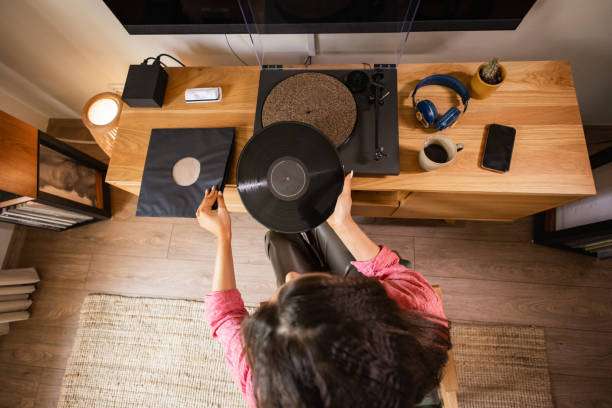
Summarize:
If you’ve already invested time and budget in a vinyl record player but still feel the sound is “not right,” take a break and look at the room itself.
Space isn’t a limitation; it’s part of the system.
Re-examine your placement and room structure, and choose a vinyl record player configuration that is more suitable for the current space so that you can hear its true sound every time the pin falls.

