Where does the warmth of a vinyl record player’s sound come from?

Many people who are new to vinyl records have a similar feeling: “The sound doesn’t seem that ‘clean,’ but it’s very comfortable to listen to.” This “warmth” that is repeatedly mentioned is not a mystery or a simple psychological suggestion but the result of the combined effects of physical structure, signal path, distortion characteristics, and human auditory habits.
This article will systematically break down the source of the warmth in the vinyl record player’s sound from a popular science perspective, helping you truly understand “why it sounds the way it does.”
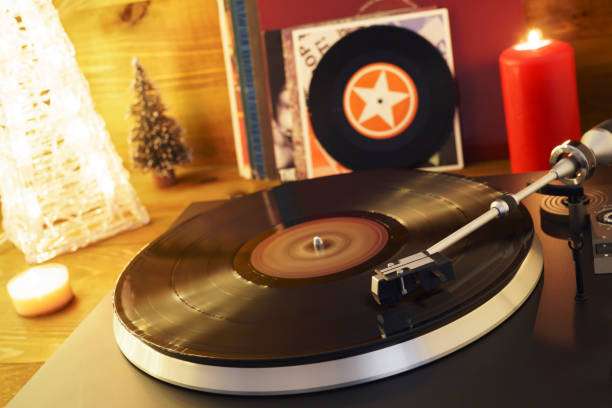
What is the feeling of warmth that we often talk about?
In the field of audio, “warmth” is not a strict technical parameter but rather a description of auditory sensation, which typically includes the following characteristics:
The mid and low frequencies are full and have depth.
The high frequencies are not harsh, and the edges are slightly soft.
The overall sound is closer to “continuous” than “sharp.”
Listening for extended periods is less tiring
When people talk about the sound of vinyl record players, this feeling is often more easily perceived than “resolution” or “separation.”
Analog signals themselves are the foundation of warmth.
1. Vinyl: Vinyl is a continuous physical waveform.
Unlike digital audio, vinyl records record continuously varying physical amplitudes. As the stylus moves through the grooves of the record, its vibration trajectory directly corresponds to the sound waveform.
This means:
No sampling points
No quantization error
No reconstruction filter
by a vinyl record player is inherently closer to the continuous state of real sound waves.
2. Digital audio is “too accurate,” which can make it sound cold.
Modern digital audio strives for extremely low distortion and extremely high resolution, which is a technological advancement. However, for the human ear, overly sharp high frequencies and transients are more likely to cause auditory fatigue.
In contrast, the slight deviations inherent in vinyl systems make the sound more “human.”
The mechanical contact between the stylus and the record is one of the key variables.
1. The stylus is not a perfect replica.
When the stylus reads the groove, it is subjected to:
friction
micro-vibration
Material elasticity
mechanical inertia
These factors introduce very slight nonlinear changes, which tend to be concentrated in the low- to mid-frequency region.
This is one of the key reasons why the vinyl record player has a “thick” sound.
2. Different styluses produce noticeably different levels of warmth.
Oval needle: Balanced sound, moderate warmth
Loose diamond needle: higher resolution, slightly less warmth.
Conical needle: Less detail, but a mellow sound.
This is why old-school audiophiles spend a lot of time adjusting the stylus rather than just looking at the parameter table.
RIAA Curve: An Underrated Warmth Maker
1. Vinyl records are not original sound recordings.
When burning records, the RIAA equalization curve is used:
Reduce low frequency
Enhanced high frequency
During playback, the phono preamp processes the data in reverse:
Boost low frequency
Attenuation of high frequencies
This process inevitably introduces phase shifts and slight distortion.
2. The vocal characteristics of the singer have a huge impact.
Different vocal arrangements have different approaches to RIAA restoration:
Slightly accurate: The sound is clear but slightly cold.
Musicality-oriented: Thicker bass, smoother treble
Therefore, the same vinyl record player can sound completely different depending on the phono preamp used.
Analog Distortion: Why does distortion sometimes sound better?
1. The distortion in vinyl records is mostly due to even harmonics.
The human ear does not perceive distortion in the same way:
Even harmonics → similar to natural overtones
Odd harmonics → Easily harsh to the ear
by a vinyl record player is mainly concentrated in the even harmonic range, making it easier for the brain to perceive.
2. Slight distortion makes the sound more “three-dimensional.”
These slight harmonic superpositions can affect the human voice and musical instruments:
Further forward
Thicker
It is easier to generate emotional resonance
This is precisely why many people feel that vinyl records “have emotions.”
The overall system matching determines the upper limit of warmth.
1. Turntable stability
Slight fluctuations in rotational speed (wow & flutter) can cause:
Slight pitch shift
The voice is more relaxed
A moderate amount of drift actually makes the music sound more natural.
2. Amplifier and speaker matching
Even on the same vinyl record player:
Paired with a transistor amplifier → Cleaner output
Paired with a tube amplifier, the warmth is significantly enhanced.
The warmth doesn’t come solely from the player itself but is created by the entire system.
The first time I seriously listened to a vinyl record player was on a friend’s inexpensive system.
We were playing an old jazz album; the background noise was clearly audible, but the trumpet and vocals sounded remarkably natural.
At that moment, I suddenly understood:
The charm of vinyl records lies not in their “perfection,” but in their “authentic imperfection.”
VIII. Clarification of Common Misconceptions
1. Warmth ≠ Blurry sound
A good vinyl record system can still provide clear and accurate positioning.
2. It’s not true that older people are warmer.
The condition and preservation method of old records are more important than their age.
3. Vinyl records are not a universal filter.
Improper system tuning can also result in muffled or harsh sound.
FAQ:
Q1: Do all vinyl record players have a warm sound?
Not necessarily. Design, stylus, and phono preamp all affect the final listening experience.
Q2: Can digital players simulate this warmth?
They can get close, but the physical mechanisms are different, so the listening experience will still be different.
Q3: Will warmth affect resolution?
Within reasonable limits, no, it will actually make the details more pleasant to listen to.
Q4: Do beginners need to pursue extreme warmth?
No, balance and nature are more important.

Conclusion:
The “warmth” of a vinyl record player is not due to any single component but rather the result of the combined effects of analog signals, mechanical structure, and auditory psychology.
If you’re looking for a listenable, authentic, and emotionally resonant music experience, rather than just cold, hard specs, then a well-tuned vinyl record player is still worth your serious consideration.
If you’re considering buying or upgrading your system, why not start with a vinyl record player that has a clear sonic character and a stable structure and gradually build your own listening world?

