
“Stick skipping” is a problem that almost everyone encounters when
using a vinyl record player. The music is at its most emotionally charged point, but the stylus suddenly skips, interrupting the melody, or even bouncing back to the previous groove—this experience not only ruins the listening experience but also makes one wonder: Is the record broken? Is the equipment faulty?
However, if you delve into how the vinyl record player works, you’ll discover that skipping is never caused by a single reason but rather by a combination of mechanical, physical, and user habits.
In this article, we will start from the “real reasons” and explain the problem of skipped stylus in a vinyl record player in one go.
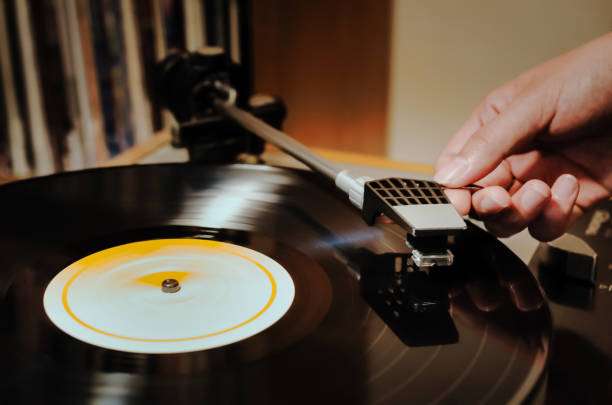
First, let’s clarify a misconception: skipping notes ≠ poor record quality.
When many people encounter skipped records for the first time, their first reaction is often that there’s a problem with the record pressing or that the record is too old or has scratches.
However, extensive practical use reveals that:
The same record sounds completely different on different vinyl record players.
Some new records also skip.
Some old records can be played stably on the right set of equipment.
This illustrates that the condition of the vinyl record player itself is often more crucial than the record itself.
One of the core reasons for stylus skipping is incorrect tracking force.
In a vinyl record player, the stylus needs to be pressed firmly against the grooves of the record with a certain amount of downward pressure; this pressure is called tracking force.
What happens if the tracking force is too light?
The stylus cannot be stably pressed against the bottom of the engraving.
It tends to “bounce” when playing low-frequency or dynamic music.
Even slight vibrations can cause skipped stitches.
What problems might arise if the tracking force is too strong?
The number of skipped needles may decrease in the short term.
However, this will accelerate the wear and tear on the stylus and record over time.
The sound quality details actually decreased.
Many vinyl record players are not precisely tuned at the factory, especially mid- to low-priced models, which require users to calibrate them themselves.
Anti-Skate setting imbalance
Anti-slip force is specifically designed to counteract the inward pulling force of the stylus during rotation.
If the anti-slip setting is incorrect when using a vinyl record player:
Insufficient anti-slip force: The stylus is more likely to slide inward and skip.
Excessive anti-slip force: The stylus is pulled outwards, making it impossible to track stably.
A common phenomenon is that
One side of the record skips frequently, while the other side is normal. This is often related to the anti-slip setting.
The tonearm level and bearing condition were severely underestimated.
A tonearm is not just a component that “can move.”
1. The tonearm is not level.
If the vinyl record player is not placed flat:
The direction of force on the stylus shifts.
Excessive pressure on one side of the engraving
The needle is more likely to skip and get out of control in areas with complex engravings.
2. Abnormal tonearm bearing damping
If the tonearm bearing is too tight or worn out:
Tiny vibrations cannot be absorbed
The ability to follow the engravings in singing has decreased.
What appears to be a “slight jolt” is enough to cause the stylus to jump off the track.
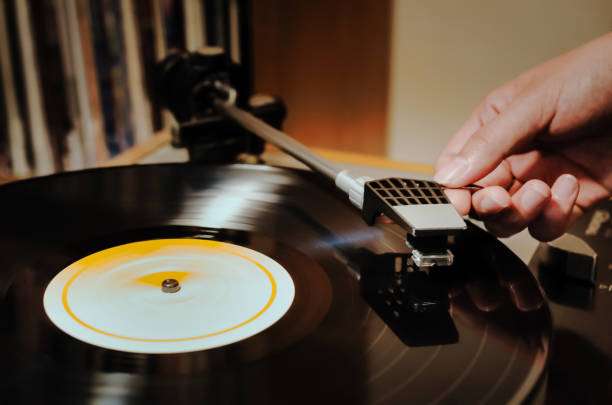
Problems with the stylus and cartridge itself
Stylus wear
When the stylus has been used for too long:
The shape of the needle tip changed
Abnormal area and angle of contact etching
Even with the correct tracking force, slippage is still possible.
Stylus type mismatch
Different stylus structures (such as conical, elliptical, and line contact) have different requirements for tracking ability.
Some styluses, while offering higher resolution, are also more sensitive to the calibration precision of vinyl record players.
The condition of a record engraving is not as simple as “whether there are scratches.”
Even if the record looks brand new:
Dust attracted by electrostatic electricity
Grease residue
Tiny impurities left by improper cleaning
These will create “obstacles” inside the engravings, causing the stylus to temporarily lose stable contact.
This problem is amplified, especially when playing music with a lot of low frequencies and a wide dynamic range using a vinyl record player.
Environmental vibration: an overlooked yet very real factor
Many people only realized this later:
The speaker and vinyl record player are placed on the same desktop.
Wooden floors vibrate when walked on.
Desktop Resonance
All of these factors affect the stability of the stylus directly through structural transmission.
Sometimes you’ll find that the phonograph needle starts to move around restlessly whenever you walk around or close a door, and this is no coincidence.
Why do some people “never skip a needle”?
It wasn’t good luck; they simply met these conditions unintentionally:
The vinyl record player is placed stably and horizontally.
Tracking force and anti-skid force are within a reasonable range
The stylus is in good condition.
Proper vibration control in the playback environment
When these conditions are met simultaneously, skipped needles will naturally decrease significantly or even disappear for a long period of time.
FAQ:
Q1: My newly purchased vinyl record player is also skipping; is that normal?
Yes, if a new machine is not properly calibrated in terms of tracking force and anti-slip force, it may also skip.
Q2: Will skipping streaks damage records?
Frequent skipping streaks can cause abnormal wear on local grooves, which is detrimental to record preservation in the long run.
Q3: Will replacing the stylus with a more expensive one solve the problem?
Not necessarily. When not properly adjusted, a high-end stylus can actually expose problems more easily.
Q4: Why are certain music genres more prone to skipping?
Music with strong low frequencies and high dynamic range places higher demands on the tracking ability of vinyl record players.
Q5: Do all skipped pins need repair?
In most cases, the problem can be solved by proper adjustment, without the need to replace the equipment.
Summarize:
The skipping of the stylus is actually the vinyl record player’s way of reminding you that
A certain part of the process wasn’t being taken seriously.
With a clear understanding of the principles and patient adjustments, most skipped-pin issues can be resolved. In the process, you’ll gain a deeper appreciation for the charm of vinyl playback systems.
If you want to reduce skipped tracks and achieve more stable tracking performance, you can focus on the following:
Clear Tracking and Anti-skid Adjustment Range
The tonearm structure is mature
Vinyl record player and accessories with better environmental vibration control
Welcome to check out our curated selection of vinyl record player products, bringing back the smoothness and completeness of music.

