How to improve bass clarity on a vinyl record player? A comprehensive guide and practical tips.

As a vinyl record enthusiast, have you ever encountered this problem: the sound is rich in layers, but the bass always seems muddy and unclear? Especially when listening to classic jazz, electronic, or rock, the bass performance directly affects the overall experience of the song. Today, we’ll talk about how to optimize your vinyl record player, tonearm settings, speaker pairings, and environmental adjustments to make your bass cleaner, fuller, and clearer.

Understanding the characteristics of bass in vinyl playback
First, it’s important to understand what factors affect bass response in vinyl playback. Compared to digital audio, the sound from vinyl playback is amplified by the physical grooves that drive the stylus directly. Therefore:
- Inappropriate stylus pressure: too light will result in insufficient low frequencies, while too heavy may cause distortion.
- Tonearm balance and angle: Inaccurate tonearm mounting can result in muddy bass or a weak bass on one side.
- Record material and wear: The low frequencies of old or defective records are inherently unstable.
- Speaker and amplifier matching: The signal output by the vinyl record player needs to be amplified by the speakers. If the low-frequency response is poor, it will directly affect the clarity.
- Environmental factors: Room resonance, placement, wall reflections, etc., can all make bass sounds muffled.
I used to own an entry-level vinyl record player, and the bass was always booming, making the drum beats sound muddy when listening to rock music. After adjusting the stylus pressure and speaker placement, the bass became much cleaner, which made me realize that improving the bass performance of vinyl records isn’t solely dependent on the brand of the player.
Optimization of stylus and tonearm
1. Adjust the stylus pressure
Vinyl record players usually come with an instruction manual, and the recommended stylus pressure is a reference value. Generally speaking:
- Entry-level stylus: approximately 1.5–2 grams
- High-quality stylus: approximately 2–2.5 grams
Too little pressure will result in loose bass, while too much pressure will increase distortion. When adjusting, start with the recommended value and let your listening experience guide your decisions.
2. Tonearm level and VTA adjustment
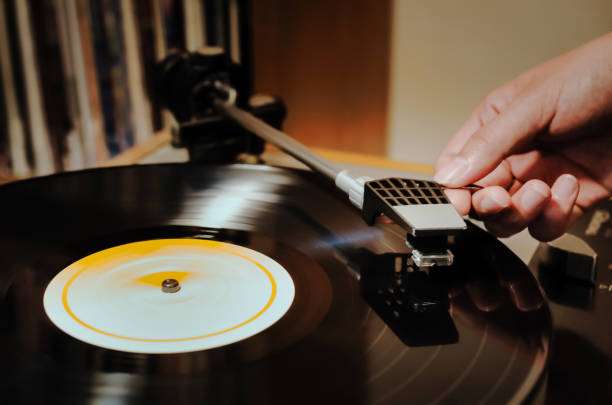
VTA (Vertical Tracking Angle) is the vertical angle between the tonearm and the record. The bass performance of a vinyl record player is highly dependent on the VTA.
- The angle is too high; the bass is too light.
- Low angle: Bass is heavy but may be muffled.
Experience sharing: My friend switched to an adjustable VTA tonearm, and his bass instantly became thicker, while the edges of the drum sound became clearer.
3. Anti-vibration tonearm base
The tonearm is mounted on a stable base, which reduces vibration interference and makes the bass output of the vinyl record player cleaner.
Amplifier and speaker pairing
1. Amplifier gain and frequency response matching
The signal output from a vinyl record player uses an RCA circuit and must be fed into an amplifier before it can drive the speakers. If the amplifier’s low-frequency response is not balanced enough, the bass will be distorted.
It is recommended to choose a power amplifier with a frequency response covering 40 Hz–20 kHz.
Avoid excessive bass gain to prevent distortion.
2. Speaker placement and bass reflection
Speaker placement is crucial for bass clarity:
- Being too close to the wall can cause low-frequency resonance and blur the drumbeats.
- With the wall 30–50 cm away and the stand height level with the ears, the bass will be more balanced.
- If the room is small, consider using low-frequency sound-absorbing panels to reduce reflections.
I used to use bookshelf speakers with a vinyl record player in my small bedroom, and the bass was always booming. Later, I added low-frequency sound-absorbing panels on both sides and slightly widened the speakers, and the bass became tighter and more elastic.
3. Crossover and active subwoofer
If using bookshelf speakers or monitor speakers, adding a small subwoofer can improve low-frequency clarity. The key is the crossover point and phase adjustment to avoid bass overlap with the main speakers, which can create a muddy sound.
Record materials and cleaning
- Premium vinyl records: Heavy vinyl (over 180 g) vibrates more stably, resulting in a more natural and cleaner bass.
- Cleaning records: Dust can interfere with the stylus’s vibration, making the bass lines muddy.
- Storage environment: Avoid humidity and high temperatures for more stable bass performance.
I have a set of old jazz records. After cleaning them, the bass is noticeably cleaner, and the drumbeats are more layered. My friends and I were amazed by the difference when we listened to them at home.
Room acoustics and placement optimization
- Placement: Too close to the wall, the bass will be too loud; too close to a corner, the bass will be exaggerated.
- Soft furnishings: Carpets, curtains, and bookshelves can reduce low-frequency reflections.
- Listening position: Form an equilateral triangle, with the ears approximately equidistant from the speaker.
Vinyl record players have stable output; without optimized room acoustics, bass can still easily become muddy.
Common bass problems and solutions
|
Question |
Possible reasons |
Solution |
|---|---|---|
The bass is loose, and the drum sound is unclear. |
Stylus pressure too light, VTA not suitable |
Adjust the stylus pressure and fine-tune the tonearm angle. |
Low-pitched, booming, muddy |
Speakers too close to the wall, room resonance | The speaker should be 30-50 cm away from the wall, with added sound-absorbing material. |
|
Uneven bass |
Amplifier frequency response inadequate, improper crossover |
Use an amplifier with frequency response covering low frequencies and adjust the subwoofer crossover. |
|
Weak bass |
Low-quality vinyl records, dirty records |
Use a high-quality record and play it after cleaning. |
FAQ
Q1: Is there a big difference in bass between vinyl record players and digital sources? The difference is significant. Vinyl playback uses physical grooves for direct drive, resulting in fuller bass, but it’s more susceptible to the effects of the tonearm, stylus, speaker enclosure, and room temperature.
Q2: Are all vinyl record players the same in terms of bass? No. Entry-level vinyl record players may have thick but muddy bass, while high-end players can achieve clearer bass through tonearm design and vibration isolation.
Q3: Is a subwoofer necessary? Not necessarily, but for bookshelf speakers and small rooms, adding a subwoofer can make the bass clearer and more layered.
Q4: Does the weight of a record affect bass? Yes. Thicker vinyl records (over 180 g) vibrate more stably and have a more robust low-frequency performance.
Q5: Can bass blur be adjusted with software or EQ? Vinyl is essentially an analog signal. EQ can improve the perception, but it cannot completely solve bass blur caused by physical reasons.

Summarize:
If you want your vinyl record player to have clean, full, and punchy bass, remember:
- Optimize stylus pressure and tonearm angle
- Pair with a frequency-balanced amplifier and speakers
- Pay attention to the room acoustics and speaker placement.
- Use high-quality vinyl records and keep them clean.
A good vinyl record player, with proper tuning, can not only deliver clear bass but also enrich the details of the entire sound. Get started now and enjoy the purest vinyl bass!

