Vinyl record player vs. vintage gramophone: differences, advantages and disadvantages, and suitable users

With the resurgence of analog audio, “vinyl culture” has become captivating once again. Whether you’re new to vinyl or looking to upgrade your home music equipment, “vinyl record player” “” and “vinyl record player” are often the two devices most frequently compared.
Although they look similar and can both play vinyl records, they are completely different in terms of structure, sound quality, operation, positioning, and target audience.
This article will take you through a deep dive into the key differences between the two and help you determine which one is more suitable for you.

Vinyl record player vs. vintage gramophone: Overview of key differences
If you’re short on time, you can first look at the quick difference table below:
| project | vinyl record player | Retro gramophone |
| sound quality | High fidelity, professional grade | It has a strong sense of atmosphere, but the sound quality is rather rough. |
| driving method | electric turntable | Manual winding or simple motor |
| Stylus/tonearm | Replaceable and finely adjustable | Fixed, non-adjustable |
| Function | Supports Bluetooth/USB/external speakers | Mostly for pure playback, with few functions. |
| Exterior Style | Modern or retro | A strong classical style with a powerful decorative effect |
| Suitable for | People who want to listen carefully to sound quality | People who like a retro atmosphere or home decor |
If you prioritize sound quality, choose a vinyl record player; if you’re looking for ambiance or home décor, a vintage gramophone is more suitable.
What is a vinyl record player? Why is it more professional?
Vinyl record players are the mainstream form of modern vinyl playback devices, emphasizing sound quality, stability, and adjustability.
Key features:
The tonearm and cartridge can be upgraded
For example, replacing them with a higher-end cartridge can improve the soundstage and resolution.
stable rotation speed
of 33⅓ and 45 RPM is the foundation of good sound quality.
It supports external speakers and amplifiers
, allowing for professional system output with richer sound layers.
High-fidelity (Hi-Fi) performance
can reproduce the sound recorded in the recording studio to the greatest extent.
The first time I played “Hotel California” on an entry-level vinyl record player, the thickness of the low frequencies and the detail in the guitar made me instantly understand why so many people stick with vinyl.
What is a vintage gramophone? Why is it so charming?
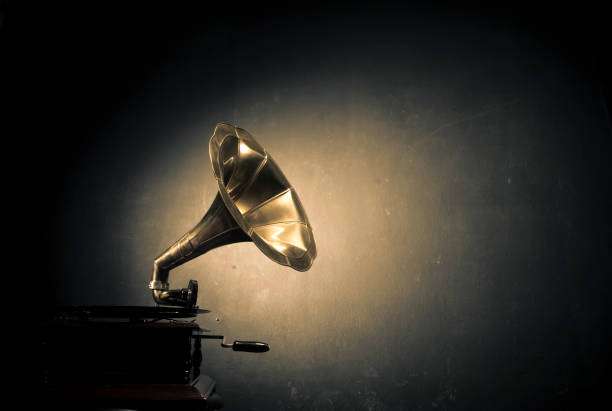
Vintage gramophones are often inspired by the designs of the early 20th century, featuring elements such as large metal horns and wooden enclosures. Their greatest appeal lies in:
Key features:
A strong sense of nostalgia in appearance
The playback process is full of ritualistic elements.
including manually winding the spring, releasing the needle, and adjusting the shell.
The sound has a grainy texture and an old movie feel.
More like a home decoration than a sound system
Many people buy vintage phonographs not because of their sound quality, but because they can instantly elevate the ambiance of a living room or study.
I once heard a friend play jazz on a vintage gramophone at his house. Although the low frequencies were not many and the sound was a bit crisp, the atmosphere of “music from the old days” was something that modern equipment could not replicate.
Sound quality difference: the biggest difference between the two
1. Sound quality characteristics of vinyl record players
The sound is more accurate and clearer.
It can showcase the spatial sense and layers in music.
A better cartridge and tonearm can significantly improve the tone.
The external system determines the final sound quality (the better the amplifier and speakers, the stronger the performance).
Whether you listen to classical, rock, jazz, or pop music, it can satisfy your high-fidelity needs.
2. Sound quality characteristics of vintage phonographs
The sound is more “nostalgic” and has a stronger graininess.
The high frequencies are slightly harsh, while the low frequencies are relatively weak.
The timbre doesn’t aim for accurate reproduction but rather for “flavor.”
3. Why is there this difference?
Vinyl record players have more precise tonearm and stylus pressure, resulting in lower distortion.
The mechanical structure of the phonograph resulted in significant vibration, noise, and poor stability.
The phonograph has a built-in speaker, and the sound has a noticeable “resonance within the box.”
In short:
Vinyl record player: Listen to the sound quality
of a vintage gramophone = Listen to the style and atmosphere
Feature Comparison: Completely Different Player Experiences
The vinyl record player is feature-rich and modern.
Bluetooth input or output (can connect to Bluetooth speakers)
USB transfer function (transfer vinyl records to a computer)
Automatic arm return, automatic stop
Can be paired with equalizers, amplifiers, and other audio systems.
Stable speed, even fine-tunable
For modern young people, these features make vinyl records easier to integrate into their daily lives.
The functions of a vintage phonograph (few but focused)
Play vinyl records
Some models can switch between 33/45/78 RPM.
Some have built-in FM radios
Most do not support Bluetooth or external devices.
If you just want to listen to vinyl records “in the background,” a vintage gramophone is sufficient. But if you want recording capabilities or to upgrade your audio system, then it’s not suitable.
Appearance and Atmosphere: The Retro Gramophone Wins Hands Over Hand
Undoubtedly, the visual appeal of a vintage gramophone is stronger:
The design is exaggerated, like a work of art.
Full of European or old Shanghai style
Perfect as a focal point of home décor
Vinyl record players do have some attractive designs; they generally lean towards a minimalist and modern style, with a greater emphasis on functionality.
If your goal is to create a café or vintage-style home, the decorative power of a gramophone is irreplaceable.
Durability and maintenance costs
vinyl record player
Replaceable parts: stylus, belt, cartridge
Easy to maintain
A good machine can last for more than 10 years.
Retro gramophone
Complex structure and high maintenance costs
Some types of gears and springs are more prone to aging.
The stylus should not be replaced arbitrarily.
Most of these are decorative devices and are not suitable for long-term, heavy use.
If you plan to listen to vinyl frequently, a vinyl record player is obviously more stable.
Target Audience Analysis: Which type are you?
A vinyl record player is more suitable:
I like Hi-Fi sound quality
People who want to listen to music seriously
Players who want an upgradeable sound system
People who like modern equipment and simple operation
People who want to experience the “real vinyl sound”
A vintage gramophone is more suitable:
I like retro-style home decor.
People who want to enhance the atmosphere of a space
Occasionally play vinyl records as background music
People who don’t particularly care about sound quality details
For those who crave a sense of ritual in their lifestyle
A simple way to tell:
Do you use vinyl records as “music” or as “decoration”?

Conclusion: How to choose between the two?
Want a professional music experience? → vinyl record player
Want a retro vibe and home décor? → Vintage gramophone
Having the budget and enjoying both experiences → Both can bring completely different levels of satisfaction.
Before making a purchase, you need to determine whether your core need is “sound quality” or “visual experience.” As long as your goal is clear, you won’t make the wrong choice.
If you’ve already decided to get a vinyl record player or a vintage phonograph, you might want to compare several popular models, starting with sound quality, features, and appearance, to find the one that best suits you and let music once again become a source of ritual in your life.

